Thursday, November 19, 2009

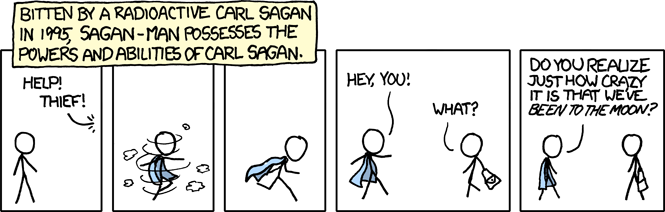
In case you were worried...

World not ending in 2012, says NASA
I think people are really, really worried about the world coming to an end. Kids are contemplating suicide. Adults tell me they can't sleep and can't stop crying. There are people who are really, really scared. People are very gullible. It a sad testimonial that you need NASA to tell you the world's not going to end.

As a Bonus!!:

 WIDTH=
http://xkcd.com/663/

Wednesday, November 18, 2009

Health Care on 4th and 2

Here's a wonderful little post about what Bill Belichick's controversial decision in the Patriots-Colts game the other night shows us about rationality and human emotions, particularly as they relate to the health care issue:

The reason I bring up this analysis is to demonstrate that even defensible decisions can have wrenching emotional consequences. Belichick's call might have been statistically correct, but it felt horribly wrong.

And this kind of contradiction isn't just relevant for football coaches. Just consider health care: the only way we're ever going to reduce medical costs is to restrict procedures that haven't passed evidence-based efficacy tests. Maybe that means 40 year old women don't get mammograms, or that we treat prostrate cancer less aggressively, or that we stop performing spinal fusion surgeries. Although there's solid evidence to question all of these medical options, such changes provoke intense debate. Why? Because our emotions don't understand statistics. Because when we have back pain we want an MRI. Because when it's our father with prostate cancer we want the most aggressive possible treatments. And so on.

The point is that there's often an indefatigable gap between the rigors of cost-benefit analyses and the emotional hunches that drive our decisions. We say we want to follow the evidence, but then the evidence rubs against a bias like loss aversion, and so we make an exception. We'll follow the evidence next time.

Tuesday, November 17, 2009

Could you tell me where the nuclear wessels are?

Months and months ago the House passed a historic climate change bill (derided by many people in the know as weak sauce) called Waxman-Markey. Not too long ago, John Kerry and Barbara Boxer came out with their own Senate counterpart to that bill. But not everyone's on board with the sort of cap-and-trade scheme that shows up in these bills. So this week two Senators from different parties combined forces to unveil an alternative. The most interesting bit is the special focus they have on one particular source of energy, mentioned right in the press release on sponsor Jim Webb's website: "Alexander, Webb Introduce Bipartisan Clean Energy Legislation with Emphasis on Nuclear Energy Investment". From the PR:
This initiative is also designed to keep the United States competitive in a global marketplace that has accelerated the development of nuclear power. While the U.S. has been at a stand-still in developing nuclear power in the last 30 years, others are forging ahead. France – with the lowest electric rates in Europe - now gets 80% of its electricity from nuclear power, while Japan’s nuclear fleet accounts for 35% of its electricity. And this week the United Kingdom announced plans to expand its reactor fleet.

I say that this emphasis on nuclear energy is interesting because the arXiv blog has a very interesting find today in a post called "The Coming Nuclear Crisis." This has nothing to do with any sort of safety issues or the disposal of waste or anything like that. The crisis is far more basic and far larger than those issues.

Nuclear power relies on fission. Certain large atoms (e.g. a particular isotope of uranium) are split into smaller atoms, releasing energy in the process. But if you don't have the right ingredients you can't do it. According to the arXiv blog:
The world is about to enter a period of unprecedented investment in nuclear power. The combined threats of climate change, energy security and fears over the high prices and dwindling reserves of oil are forcing governments towards the nuclear option. The perception is that nuclear power is a carbon-free technology, that it breaks our reliance on oil and that it gives governments control over their own energy supply.

That looks dangerously overoptimistic, says Michael Dittmar, from the Swiss Federal Institute of Technology in Zurich who publishes the final chapter of an impressive four-part analysis of the global nuclear industry on the arXiv today.

Perhaps the most worrying problem is the misconception that uranium is plentiful. The world's nuclear plants today eat through some 65,000 tons of uranium each year. Of this, the mining industry supplies about 40,000 tons. The rest comes from secondary sources such as civilian and military stockpiles, reprocessed fuel and re-enriched uranium. "But without access to the military stocks, the civilian western uranium stocks will be exhausted by 2013, concludes Dittmar.

It's not clear how the shortfall can be made up since nobody seems to know where the mining industry can look for more.

That means countries that rely on uranium imports such as Japan and many western countries will face uranium shortages, possibly as soon as 2013. Far from being the secure source of energy that many governments are basing their future energy needs on, nuclear power looks decidedly rickety.

There's a nice little bit of sunny speculation at the end of the article about the possibility of military stockpiles being used for energy production, leading to a nuclear weapon-free world. Regardless of whether that comes to pass, this apparent impending fuel shortage might be something to keep an eye on.

Bonus link

Somebody's Baking Brownies


Well, that sucked. A whole lot of nothing with a few seconds of something (horrible) in the middle leading to a 16-0 loss on national television. And maybe Cribbs got hurt in the last few seconds.

But I stand by what I wrote about Cleveland's sports teams many moons ago. In many ways, their story is the story of the city itself. Makes it all the more frustrating.

Switching sports for a moment, I also find Delonte West's battle with his mental demons very sad. I hope his better angels win.

Sunday, November 15, 2009

People Enjoy Watching the World Collapse

Maybe it's something about the trials the world is currently facing that sends movie-goers flocking to disaster porn. Or maybe a taste for the macabre is just innate in the human psyche.

“2012,” Roland Emmerich’s thriller about a global cataclysm, opened at No. 1 with a higher-than-expected $65 million in ticket sales in the United States and Canada, according to the tracking service Hollywood.com. Sony, which released the movie, estimated that it raked in an additional $160 million overseas, making the first weekend for “2012” one of the biggest of the year.

It is rare for a movie not based on a pre-existing brand, franchise or hit novel to deliver such robust results. Sony said “2012,” with a budget of $200 million, had the highest worldwide opening ever for an original movie.


I kind of want to see it.

Saturday, November 14, 2009

Student Loan Sharks

Two months ago the House of Representatives passed H.R. 3221, an important student loan bill that, among many other things, would convert all future federal student loans to Direct Loans. In Direct Loans, the government is the lender and borrowers pay them back directly. The alternative--the thing this bill eliminates--entails the government subsidizing banks to make loans to college students and guaranteeing the vast bulk of the student loan. Technically this is called the Federal Family Education Loan Program. So, in my case, the government paid my lender, Bank of America, to give me a virtually risk-less loan (since the government will back it up should I default on it).

As you can imagine, switching to an entirely Direct Loan based system of federal student loans is more efficient and saves money (up to $87 billion over the next decade). It also saves borrowers like me the pain in the ass I went through today of trying to figure out who's currently holding my Stafford loans. It turns out Bank of America sold my loan--correction: part of my loan--to another lender and keeping up on that kind of paperwork isn't my forte.

So, shoutout to H.R. 3221, the Student Aid and Fiscal Responsibility Act of 2009. May you survive the Senate.

Friday, November 13, 2009

(Flip-)Flop Goes the Weasel

I often wonder how exactly people make up their minds on political or social questions and whether their conclusions are really subject to change. Is there actually room for genuine debate in the political sphere or is the dog and pony show of scripted rejoinders cleverly designed to zoom right past the opponent in the room and into the ears of the base or other politically amendable listeners all we can hope for?

In general, I would say that political "debate" doesn't change minds because people often tend to be very discerning when it comes to facts. By that I mean they pick and choose which ones they incorporate into their world view. Inconvenient truths are ignored or perverted so that one need not change too much, if at all. At least not all at once.

Well, last May Gallup announced: More Americans “Pro-Life” Than “Pro-Choice” for First Time:


That's a 15-point swing in one year. Presumably the abortion question taps into fairly deep-core beliefs about human life, privacy, and individual, social, and governmental responsibility. Not the sort of thing you expect to see flip overnight. Perhaps I'm blanking out here but I can't think of some large event that could've impacted opinions so drastically. Was a mass abortion held on the steps of the Capitol and I missed it?

Assuming there isn't some methodological problem going on in Gallup's polling, that's damned peculiar.